
When the Process Becomes Harder Than the Project
Sometimes the complexity of the approval process begins to exceed the complexity of the project itself.
Recently we’ve been assisting a residential client who wanted to replace an ageing timber koppers log sleeper retaining wall along their boundary. The wall had reached the end of its service life and needed replacement. Complicating matters, the neighbouring property is planning an extension that will soon restrict access along the boundary, so replacing the wall now represented the last practical opportunity to undertake the works easily.
Importantly, both neighbours supported the project and were sharing the cost.
The proposal itself was straightforward:
Replace the existing timber sleeper wall with a concrete sleeper and steel post wall
Same location
Same height (approximately 1 metre)
Same fence on top
In other words, a like-for-like replacement using more durable materials.
The client contacted Council first to ensure the process was handled correctly. They were advised that a Development Application (DA) would be required.
So the process began.
The Approval Process
The DA was lodged in November 2025, including engineering drawings, survey information, sectional details of the wall, and certification.
Council’s first response was a request for a sediment and erosion control plan. Given the small scale of the works and minimal disturbance area, this type of plan is not typically required under the NSW Blue Book guidelines. However, councils do have discretion to request additional information, so the plan was prepared and submitted.
In December 2025, Council returned with a second request — this time for an elevation drawing of the retaining wall.
From an engineering perspective, this request felt disproportionate. The original drawings already included surveyed levels and sectional details clearly identifying the height of the wall and its relationship to the boundary and ground levels. Producing a formal elevation drawing for a sub-1 metre retaining wall that was replacing an existing wall in the same position did not materially add new information to the assessment.
Nevertheless, the elevation drawing was prepared and submitted.
Now, in March 2026, Council has returned again requesting a demolition plan.
For a small timber sleeper retaining wall, demolition essentially involves removing the existing sleepers and posts prior to installing the new wall. This construction sequence is implicit in the engineering documentation and typical for this type of work. Preparing a dedicated demolition plan begins to feel like documentation created simply to satisfy process rather than to meaningfully inform decision-making.
When the Process Becomes the Project
From a construction perspective, the works themselves are modest:
Remove deteriorated timber sleepers and posts
Install steel posts
Install concrete sleepers
Reinstate the boundary fence
This type of retaining wall replacement occurs thousands of times across Australia every year.
Yet in this case the design documentation and approval process are beginning to approach the complexity of the actual construction.
You can understand the client’s frustration. They started this process simply trying to do the right thing.
Should This Have Been a DA at All?
My own view is that works like this should reasonably fall under Exempt Development, or at the very least Complying Development. The DA process specifically assess planning requirements which would have all been addressed with the original wall. Planning approval essentially exists in perpetuity, so it seems that only the construction methodology could reasonably require assessment.
This situation raises some important question:
If the wall was failing and was an imminent threat to safety or property, would we still expect the same process?
Should refreshing existing infrastructure require planning approval, given that planning approval does not pertain to construction methodology or the materials used in a retaining wall?
Certifiers and planners may have different perspectives here, and it would be valuable to hear them.
A Broader Issue
This example highlights a broader issue across the planning system.
Local councils are often understaffed and managing significant workloads, while planners must operate within complex legislative and risk frameworks. That environment naturally encourages cautious decision-making.
But when relatively minor works are drawn into lengthy approval processes, the result can be unnecessary complexity for simple projects.
Over time this feeds a growing sense of disillusionment with the planning system among homeowners, builders, and consultants alike.
Is the System Working as Intended?
The intent of the planning system is to ensure development occurs responsibly and in the public interest. That objective is important.
However, when the process becomes harder than the project itself, it is worth asking whether the system is operating optimally for the people it serves.
Sometimes the best way to improve a system is to look closely at the small examples.
Because if replacing a one-metre retaining wall requires months of process and multiple rounds of additional documentation, it may be time to ask whether the balance between oversight and practicality has drifted too far.
Supporting Information
Primary Planning Pathways
The three main planning pathways used in NSW are:
Exempt Development (approval not required)
Complying Development Certificate (CDC) (approval can be gained directly with a Private Certifier)
Development Application (DA) (Council assessment, requires a construction certificate before you can build)
Further information on these can be found at the NSW Government Website
Example of Proposed Retaining Wall
The below illustrates a typical example of the proposed retaining wall replacement system. These types of walls are used extensively within the construction industry for walls typically up to 1.8m in height, and are particularly prevalent as boundary systems in residential sub-divisions. This is generally because they are:
Fast and easy to construct
Durable
Standard fixings available to support a fence
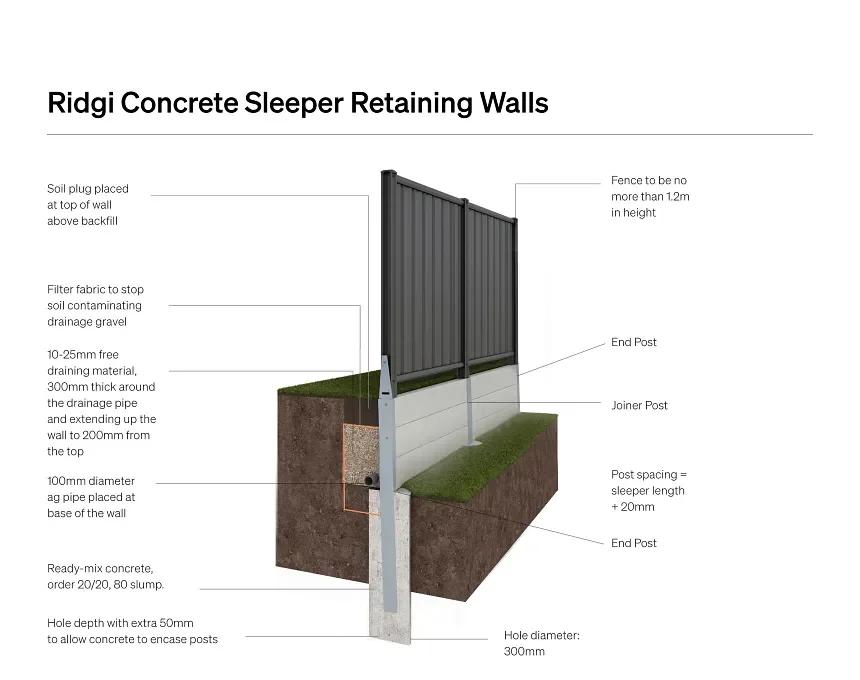
Image courtesy of Austral Masonry, who have standard solutions for this type of retaining wall, such as the Ridgi Concrete Sleeper retaining wall system.